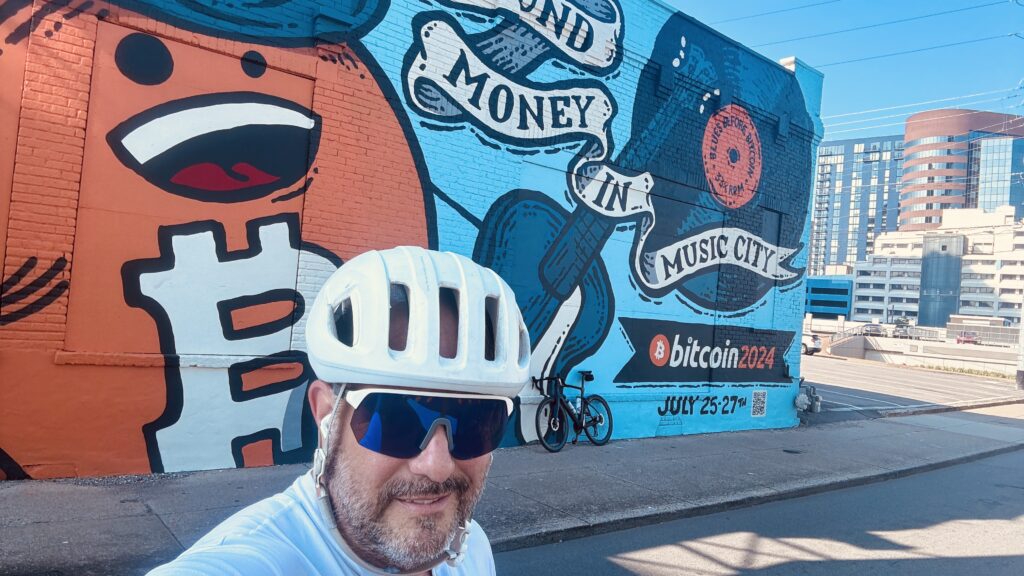
Cycling isn’t about fitness, and it never has been for me. Fitness is the byproduct, not the reason I ride. The reason is simpler: cycling is the only hour of the day where my head clears, the only place I think in a straight line, and the only training that translates to everything I build off the bike.
Since 2023, I’ve logged 33,243 miles, 773 rides, and 607,747 feet of climbing across 1,668 hours in the saddle. That is 20.9 Mt. Everests by elevation. However, people look at those numbers and assume I’m chasing fitness. I’m not. Cycling isn’t about fitness for me. In fact, it’s about staying clear-headed long enough to do real work.
Why cycling isn’t about fitness for me at 50
I’m 50. Also, I’ve ridden through every chapter of my career. The lemonade stand. Then the landscaping years in New Orleans. After that, the retail era. Also the online builds. Whinstone in Rockdale, Texas, later acquired by Riot Blockchain. Now Savrn and the AI Factory.
In every chapter, the bike was there. Before the meeting. After the meeting. Sometimes instead of the meeting. Therefore the fitness was a side effect. The clarity was the point.
Fitness fades, the habit holds
Anyone who has trained for a hard goal knows fitness comes and goes. You peak. You taper. Then you get hit by a car at 100 miles into a ride, and you spend six weeks water-jogging in a pool. The fitness leaves. However, the habit doesn’t.
The habit is the asset. In fact, the habit is what shows up at 5am in 38-degree drizzle. The habit is what makes me roll out on a Tuesday after a brutal Monday. So I ride anyway. Cycling isn’t about fitness because the fitness is the easy part to lose.
The “I rode anyway” anchor that proves cycling isn’t about fitness
“I rode anyway” is the through-line. Hot. Cold. Travel day. Hotel gym only. Headwind both directions. I ride anyway. Then I write about it. Then I do the work the rest of the day.
The “anyway” is the operating principle. Because if the workout is conditional on perfect conditions, it isn’t a practice. It’s a hobby. And hobbies fade.
Conditions don’t matter on the bike
I’ve ridden in 21-degree Dallas cold mornings. Also in Louisiana humidity that fogs the lens on my Insta360 X5. I’ve ridden Pinarello miles after red-eyes and before board calls. The bike doesn’t care.
That’s the gift. Cycling isn’t about fitness or comfort or weather. Instead, it’s about the decision to roll out. Once I roll out, the rest is just pedaling.
The routine compounds
A single ride is a workout. A thousand rides is a personality. The 773 rides in my Strava history aren’t a fitness log. Furthermore, they’re a pattern of decisions, repeated, over and over.
That pattern is what compounds. Then the fitness is the receipt for the discipline, not the goal.
What the bike actually trains
People assume cyclists train their legs. We do, of course. However, the bike trains things that show up nowhere on a power meter.
Patience under load
A long climb teaches patience the way nothing in a conference room does. You can’t will yourself up Mt. Diablo faster than your sustainable output. Therefore you hold the watts you can hold. You wait. You finish.
That’s the entire posture I bring to building anything substantial. Whinstone wasn’t built in a sprint. Neither is Savrn. In short, the bike taught me to stay in zone two when zone five looks more dramatic.
Decision-making under fatigue
The decisions I make at hour four of a ride are the decisions that reveal who I actually am. Hydrated and fresh, I’m fine. However, bonking and 80 miles deep, my real defaults show up.
That’s why I train. Not for the watts. For the data on how I behave when the wheels start to wobble. Because cycling isn’t about fitness for that exact reason. Fitness is the easy metric. Character is the metric I care about.
The dog gets a vote on the ride
Shadow runs with me on the short rides. He doesn’t care about my FTP. He cares that we’re out there.
That, too, is the lesson. The audience for the ride is one rescue dog, my own head, and the road. So the fitness reading on Strava is a footnote.
33,243 miles of evidence that cycling isn’t about fitness
The numbers from the homepage are real, current, and audited against the Strava feed before this post went live. Since 2023, the receipts are clear:
- 33,243 miles ridden
- 773 rides logged
- 607,747 feet of elevation gained
- 1,668 hours in the saddle
- 20.9 Mt. Everests by climbing
That’s an average of about 45 miles per ride and just over 2 hours per ride. Across nearly three years. In every city I’ve worked from. In every season. Through travel, builds, capital raises, and one rescue dog adoption (see more rides on Dispatches).
If this were about fitness, I’d have flat-lined at 600 miles a month and called it good. I didn’t. Because cycling isn’t about fitness. It’s about staying in the discipline of moving forward, every day, regardless of conditions.
What I tell people now: cycling isn’t about fitness, it’s identity
When people ask me how I keep riding through everything, I tell them this. The ride is who I am, not what I do. Fitness is what comes from being who I am. It is not the other way around.
That reframe is the whole post. Also, it’s the whole career arc, if I’m being honest. Build because it’s who you are. Ride because it’s who you are. The fitness, the revenue, the build outcomes, all of those are downstream of identity, not upstream of it.
The mistake I see most often
The mistake I see most often, in both cycling and building, is treating the practice as a means to a metric. Build to hit a number. Ride to hit a target. Then the number drops, or the target slips, and the practice goes with it.
However, the practice is the point. The number is the receipt. That is the whole reframe of cycling isn’t about fitness in one sentence.
Why cycling isn’t about fitness for builders
I talk to a lot of operators who are trying to get into cycling because they heard it helps with focus. They want a productivity hack. However, the bike doesn’t work that way. The bike pays you back only when you stop treating it as an input to another goal.
In fact, the move that unlocked the cycling-as-clarity benefit for me was the move that decoupled it from a target. Once I stopped riding to hit a watts number and started riding to be a person who rides, the clarity showed up. That’s why cycling isn’t about fitness translates so directly into how I build.
What I’d tell a 25-year-old me
If I could go back to 1998 and hand 25-year-old me a note, it would be a single line. Build the practice, not the metric. The race in Montreal that year proved it on the body. Every chapter since has proved it on the build.
Furthermore, the 50-year-old version of me has the receipts that 25-year-old me didn’t yet have. 33,243 miles. 773 rides. Three decades of practice that survived every chapter change. The bike was the constant. Then the principle hardened around it.
The advice I actually give
When founders ask me how to start, I tell them not to start with cycling. Start with whatever the practice already is. Running, lifting, swimming, walking the dog. The form factor is irrelevant. The discipline of doing it regardless of conditions is the part that compounds.
However, if they want to try cycling, I tell them to buy the bike they would actually want to be seen on. The right gear lowers the friction. So the right gear is part of the practice, not a vanity tax. In short, set up the practice to win and the rest follows.
What’s next on the bike, and what’s next off it
Next year is more of the same. More miles. Also more rides. Then more elevation. The bike doesn’t change much. However, the chapters of work I’m building around it do.
The AI Factory work at Savrn is the next big build. Also, the bike rides through that one the same way it rode through Whinstone, through the online years, and through the New Orleans landscaping era before that. In short, cycling isn’t about fitness; it’s about being the kind of person who rides anyway, builds anyway, and shows up regardless.
The next ride is tomorrow morning at 5am. Hot or cold. Tired or fresh. The pattern is the point. That’s the whole reason I keep writing about this. Because the principle only gets stronger when it gets named.
Updated: 2026-05-11